The death of actor Robert Conrad on February 8 brought on a slew of remembrances from fans online, most notably those who recalled him shirtless, in tight pants, and often tied up, in the unusual hit TV series The Wild Wild West.
That the show's barely disguised erotic aspects aroused many gay men (mostly teenagers at the time) is self-evident in any of the show's episodes. It also brought forth several memories of my first published short story, and how my own meager PR skills at the time seem fairly quaint.
In The Wild Wild West, which premiered in 1965, Conrad played James T. West, a
James Bond-like agent who used innovative tactics and futuristic
gadgets (steampunk before there was such a thing, and futuristic for the 1800s) to battle bizarre villains.
As a youngster in grade school, the homoerotic aspects perhaps eluded me. I do recall owning a denim vest that made me feel cool like James West, and, imitating one of West's many gadgets, I even tried to insert a penknife in one of my shoes. That didn't turn out well.
What did turn out well, in my vague memory, was a Show and Tell grade school morning where, after possibly hours of rehearsal, I enlisted several other boys to reenact almost an entire episode of the show. Had we audiotaped it? Written down a script? I don't recall, other than constructing a large cardboard wall for one of the boys to crash through.
Some claim that the show may have even had an influence in the rise of gay BDSM culture. As Jack Fritscher, editor of Drummer magazine wrote in my query:
"Robert Conrad was an archetype of the
classic American physique, leather-and-western clothing fetish, and
bondage action considered basic by the founders of Drummer. Publisher John Embry wrote about his personal passion for 'Bob' Conrad. Drummer was built on a continuing series of pictures of hunky movie stars in S&M situations that began in Drummer #1, June 1975, with Paul Newman, Burt Reynolds, Steve McQueen, and Robert Conrad.
"We featured the peerless Conrad in Drummer issue #1 to set a certain 'tone' by offering his shirtless poster for sale in Drummer mail-order. A torso cover drawing by Bud of LA referenced Conrad's famous
stripped torso on display in bondage in nearly every episode of Wild Wild West, the series that brought thousands of young gays out and led them to Drummer and Folsom Street."
While SM gay culture was thriving elsewhere, my own introduction to the show was in syndication in the 1970s. Our family had moved our older television to the basement, and a northern Ohio TV station, WUAB, broadcast a set of shows, including Gilligan's Island, Bewitched, I Dream of Jeannie and others.
But The Wild Wild West remained my favorite, as my teenage libido was struck by Conrad's feisty antics, frequent shirtless scenes, and his very tight pants. Never before, or since, had a male actor's body been so blatantly put on display, along with his dashing outfits.
Jump ahead to the early 1990s, as my years of (mostly hand-written or manually-typed) scribblings developed into a few novel beginnings and a few short stories. I had begun to befriend authors and editors, mostly through my fledgling journalism efforts at Outweek, and somehow managed to be invited to contribute to a new anthology of fiction edited by prolific author and editor Ethan Mordden.
Having just learned the basics of word processing, I found that my story about being bitten by a dog, and receiving my first G.I. Joe doll as a boy, grew into a long list of TV and pop culture crushes. As a play on scholarly writing, I added footnotes to various actors and cartoon characters.
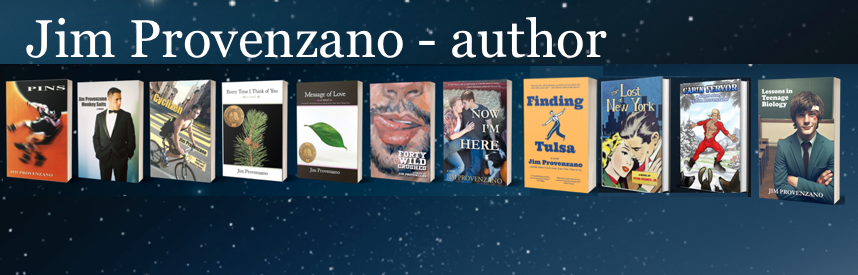
"Forty Wild Crushes (or Whenever I See a Dachshund I Think of G.I. Joe)" became part of Waves: An Anthology of New Gay Fiction. Contributors included John Weir, Brad Gooch, Scott Heim, Michael Cunningham and several others.
Showing posts with label media. Show all posts
Sunday, February 9, 2020
Saturday, November 16, 2019
Author Q&A with Jim Provenzano - Now I'm Here and other novels
In my new Q&A with NF Reads, I share a few secrets about writing, book covers and creative inspiration.
An excerpt:
What are the real-life stories behind your books?
That’s a frequent question at readings. Reality and creativity are so blended that a pat answer could be ‘everything and nothing is a real-life story.’
That said, I have a few examples.
In Now I’m Here, my latest published novel, Joshua plays piano and gets a little bit of fame for playing a piano solo version of Queen’s “Bohemian Rhapsody.” I actually did play the song for a piano recital in high school, but Joshua’s later larger TV show fame is made up.
David was raised on a pumpkin farm, and I actually worked on an Ohio pumpkin farm, but only for one season. This shows how I take a small bit of my own life, and years later, grow those experiences into fiction.
What inspires your creativity?
A scene or story that simply will not go away often serves as a spark to writing. I’ve been writing since I was a child. I even made little hand-drawn comic books on colored paper as gifts for my family, which provided a very nurturing environment.
How do you deal with creative block?
I do something else. I don’t consider non-writing periods as a ‘block,’ as much as times when I write elsewhere; at work, on my blog (www.jimprovenzano.blogspot.com), or when I assign myself an interview at work.
I love my job, which sometimes includes interviewing performers and celebrities. Being forced to condense an interview and briefly yet accurately tell their story, on deadline, aids my other writing.
In the ‘90s, I spent my early years growing the early drafts of several novels. By 2011, I’d planned to get back to Now I’m Here, but the first spark of inspiration for Every Time I Think of You came to me in a dream. At first, I cranked out what I thought might be a nice short story, then by dawn, went back to sleep, knowing it would become much more.
I kept imagining more scenes, and since I’d struggled for years with previous works, I gave myself a deadline; 500 words a day, and nine months to finish.
It became a very exciting year. With three published novels, I had more confidence, but also imagined a singular audience. It was like riding a bicycle, knowing it could work, that the two main characters, even secondary ones, fascinated me, especially when my brain decided they would do things I hadn’t expected.
Read more at www.NFreads.com
An excerpt:
What are the real-life stories behind your books?
That’s a frequent question at readings. Reality and creativity are so blended that a pat answer could be ‘everything and nothing is a real-life story.’
That said, I have a few examples.
In Now I’m Here, my latest published novel, Joshua plays piano and gets a little bit of fame for playing a piano solo version of Queen’s “Bohemian Rhapsody.” I actually did play the song for a piano recital in high school, but Joshua’s later larger TV show fame is made up.
David was raised on a pumpkin farm, and I actually worked on an Ohio pumpkin farm, but only for one season. This shows how I take a small bit of my own life, and years later, grow those experiences into fiction.
What inspires your creativity?
A scene or story that simply will not go away often serves as a spark to writing. I’ve been writing since I was a child. I even made little hand-drawn comic books on colored paper as gifts for my family, which provided a very nurturing environment.
How do you deal with creative block?
I do something else. I don’t consider non-writing periods as a ‘block,’ as much as times when I write elsewhere; at work, on my blog (www.jimprovenzano.blogspot.com), or when I assign myself an interview at work.
I love my job, which sometimes includes interviewing performers and celebrities. Being forced to condense an interview and briefly yet accurately tell their story, on deadline, aids my other writing.
In the ‘90s, I spent my early years growing the early drafts of several novels. By 2011, I’d planned to get back to Now I’m Here, but the first spark of inspiration for Every Time I Think of You came to me in a dream. At first, I cranked out what I thought might be a nice short story, then by dawn, went back to sleep, knowing it would become much more.
I kept imagining more scenes, and since I’d struggled for years with previous works, I gave myself a deadline; 500 words a day, and nine months to finish.
It became a very exciting year. With three published novels, I had more confidence, but also imagined a singular audience. It was like riding a bicycle, knowing it could work, that the two main characters, even secondary ones, fascinated me, especially when my brain decided they would do things I hadn’t expected.
Read more at www.NFreads.com
Wednesday, October 2, 2019
PINS 20th Anniversary; Wrestling with the Publishing Industry
This week is the
twentieth anniversary of the publication of my debut novel, PINS, a wrestling coming-of-age story about patron saints, headlocks, crash diets, thrash metal, dogpiles, nutpulls, and only the occasional assault.
It's been a long fascinating journey from those first scratches of writing (I started with Chapter 16, by the way) to having not one but two high-powered agents fail to sell the book, then 56 rejection letters, most brief, a few quite educational, to self-publishing the book the old-school way by starting a sole proprietorship home office, shipping cartons to wholesalers across the country while having a stack of cartons serve as a hard makeshift sofa in my living room, to creating ebook, stage and audiobook adaptations, and even getting a German translation. This was all while actually wrestling for 14 years and winning a few matches.
Yes, to paraphrase SNL actor Garrett Morris' baseball-playing character, 'wrestling's been very very good to me.'
The story follows Joey Nicci, a 15-year-old Catholic boy and his family after they've moved from Newark, New Jersey to the small nearby suburb of Little Falls. Joey's crush on his wrestling teammate Donny "Dink" Kohrs leads him to joining Dink and a few other teammates in increasing dangerous activities that lead to the death of a teammate. While Joey narrowly escapes jail, the second half of the novel focuses on his outcast status, and a layered religious theme, to the point of Joey's near-martyr-like near-death.
And yes, it is spelled PINS, not Pins. That word/acronym takes on multiple meanings in the novel, including one (spoiler), a different term for juvenile delinquents used in the New Jersey state court system of the time: Person in Need of Supervision.
That's just one of the many research tidbits that helped shape the novel, while I was simultaneously writing others, since 1991 when I inherited a tiny Mac and stayed up too many nights struggling with them all, like a garden of prose (not unlike the scraggly garden next door to my early 1990s East Village apartment where it all began) after watching, and videotaping, a few TV shows about a violent crime (The Hail Mary murder), a wrestling team gang assault (covered on The Phil Donahue Show) and being haunted by the atmosphere at a Queens protest after the murder of Julio Rivera, to whom the novel is dedicated.
Old-Schooled
By May 1997, as a graduate in the Master of Arts English/Creative Writing program at San Francisco State University, an early version on the other-titled manuscript was my thesis. But it wasn't the only novel I was working on.
I must have really annoyed my fellow novel-writing classmates when, instead of submitting the same reworked manuscript as others did, I switched gears and shared works-in-progress of what would become my third, fourth and (hopefully seventh and eighth) novels.
But the wrestling novel soon became my main focus. You can read a hardbound embarrassing early version of PINS at the university's library (a requirement for completing the degree). But even then, I had some intense interactions with a few wrestlers, both good and bad, that would change the story even more.
It would be nice to say that things would have been more successful if either of my two high-powered agents had sold PINS by 1998. But in retrospect, it wasn't finished. It wasn't even called PINS.
It's been a long fascinating journey from those first scratches of writing (I started with Chapter 16, by the way) to having not one but two high-powered agents fail to sell the book, then 56 rejection letters, most brief, a few quite educational, to self-publishing the book the old-school way by starting a sole proprietorship home office, shipping cartons to wholesalers across the country while having a stack of cartons serve as a hard makeshift sofa in my living room, to creating ebook, stage and audiobook adaptations, and even getting a German translation. This was all while actually wrestling for 14 years and winning a few matches.
Yes, to paraphrase SNL actor Garrett Morris' baseball-playing character, 'wrestling's been very very good to me.'
The story follows Joey Nicci, a 15-year-old Catholic boy and his family after they've moved from Newark, New Jersey to the small nearby suburb of Little Falls. Joey's crush on his wrestling teammate Donny "Dink" Kohrs leads him to joining Dink and a few other teammates in increasing dangerous activities that lead to the death of a teammate. While Joey narrowly escapes jail, the second half of the novel focuses on his outcast status, and a layered religious theme, to the point of Joey's near-martyr-like near-death.
And yes, it is spelled PINS, not Pins. That word/acronym takes on multiple meanings in the novel, including one (spoiler), a different term for juvenile delinquents used in the New Jersey state court system of the time: Person in Need of Supervision.
That's just one of the many research tidbits that helped shape the novel, while I was simultaneously writing others, since 1991 when I inherited a tiny Mac and stayed up too many nights struggling with them all, like a garden of prose (not unlike the scraggly garden next door to my early 1990s East Village apartment where it all began) after watching, and videotaping, a few TV shows about a violent crime (The Hail Mary murder), a wrestling team gang assault (covered on The Phil Donahue Show) and being haunted by the atmosphere at a Queens protest after the murder of Julio Rivera, to whom the novel is dedicated.
| The author in 1999. photo: Rick Gerharter |
By May 1997, as a graduate in the Master of Arts English/Creative Writing program at San Francisco State University, an early version on the other-titled manuscript was my thesis. But it wasn't the only novel I was working on.
I must have really annoyed my fellow novel-writing classmates when, instead of submitting the same reworked manuscript as others did, I switched gears and shared works-in-progress of what would become my third, fourth and (hopefully seventh and eighth) novels.
But the wrestling novel soon became my main focus. You can read a hardbound embarrassing early version of PINS at the university's library (a requirement for completing the degree). But even then, I had some intense interactions with a few wrestlers, both good and bad, that would change the story even more.
It would be nice to say that things would have been more successful if either of my two high-powered agents had sold PINS by 1998. But in retrospect, it wasn't finished. It wasn't even called PINS.
Saturday, July 13, 2019
Great Book, A-hole Author: Should we judge writers for their work and their lives?
![]() |
| author Dale Peck |
One could start with the earliest classic stories by Homer and judge Greek culture for its dubious ethics about sexual relationships between men and boys.
Jumping forward several centuries, similar critiques can be made about author Horatio Alger and his series of books about strapping young boys who enjoyed the support of rich older men. Sexual favors lurk between the lines in many of his tales. And the author, according to Wikipedia, in 1866, "had been charged with 'the abominable and revolting crime of gross familiarity with boys.' Alger denied nothing, admitted he had been imprudent, considered his association with the church dissolved, and left town."
Switching gears to machismo in men of letters, Ernest Hemingway was known to drink to excess, shoot off guns and be abusive to women. Does that mar the legacy of classics like For Whom the Bell Tolls?
![]() |
| Gertrude Stein |
"Throughout her life Stein hewed to the political right, even signing up to be a propagandist for an authoritarian, Nazi-dominated political regime," writes Will.
Also, "Most of Stein’s critics have given her a relatively free pass on her Vichy sympathies. Others have tried to ignore or justify equally inexplicable events: for example, Stein’s endorsement of Adolf Hitler for the Nobel Peace Prize in 1934, or her performance of the Hitler salute at his bunker in Berchtesgaden after the Allied victory in 1945. Until recently, in fact, the troublesome question of Stein’s politics didn’t really figure in debates over her legacy—as opposed, for example, to the vehement debates surrounding Mussolini supporter and modernist poet Ezra Pound."
Will also mentioned Pound."The modernist writer Ezra Pound took a similar tack in his propaganda on behalf of Mussolini. In his book Jefferson and/or Mussolini, Pound credited Italian fascism with bringing back “Jeffersonian” economic and agrarian values to the modern world."
This, course, omits the facts that Jefferson, a politician and author, was also a slave-owner who fathered children with a female African slave. Are we to disdain Jefferson's eloquent writings as hypocritical? Should we tear down monuments to him, as many Southern cities and universities have done with statues commemorating Robert E. Lee and other Confederate historical figures? Need we remind adherents to the Civil War, waving their 'Old Dixie" flags from their truck beds, that the South lost the war?
Labels:
arts,
authors,
books,
boycott,
celebrities,
censorship,
famous people,
fiction,
gay authors,
heteronormativity,
homophobia,
LGBT,
literature,
media,
political art,
politics,
Republicans,
social issues
Saturday, May 18, 2019
Everyone Dies: Games of Thrones, fan disappointment and delusions in fiction and fantasy
On this rainy Saturday, while I'm looking forward to this evening's plans, I feel, like many others, a sense of dread and worried anticipation for the series finale of Games of Thrones tomorrow night. Fan outrage over the last episode has reached such a tumult that nearly 700,000 people have signed a petition demanding a re-shoot of their favorite TV show.
It sounds completely absurd to non-fans, but there's a reason for it. I'll explain, and of course tie in concerns about the comparatively tiny yet related themes in my novels.
First off: massive spoiler alert. If you're at all aware of pop culture and entertainment, you know that the last episode featured 'Mother of Dragons' Danerys Targaryen taking a 'mad' turn by ignoring the tower bells that signaled the surrender of the army at King's Landing. In a seemingly abrupt move, Dany foists her fire-spewing dragon over the city, killing soldiers and citizens alike in a violent spectacle of destruction. Several characters die dramatically or disappointingly. Arya witnesses the destruction and mass deaths on ground level, and Dany and her dragon are removed from close focus to become a flyover horror.
It sounds completely absurd to non-fans, but there's a reason for it. I'll explain, and of course tie in concerns about the comparatively tiny yet related themes in my novels.
First off: massive spoiler alert. If you're at all aware of pop culture and entertainment, you know that the last episode featured 'Mother of Dragons' Danerys Targaryen taking a 'mad' turn by ignoring the tower bells that signaled the surrender of the army at King's Landing. In a seemingly abrupt move, Dany foists her fire-spewing dragon over the city, killing soldiers and citizens alike in a violent spectacle of destruction. Several characters die dramatically or disappointingly. Arya witnesses the destruction and mass deaths on ground level, and Dany and her dragon are removed from close focus to become a flyover horror.
Saturday, March 30, 2019
Self on a Shelf: Interabled Relationships, Queen movie's censorship, and other not-yet-abandoned topics in my novels
![]() |
| Bohemian Rhapsody in China = NoHomo |
Granted, my novels will always be about gay men and the depiction of their humanity. But the specific themes and interests have to be stored and cherished, then put on a mental (and actual) side shelf to make way for new exploration, unless you're the kind of artist who continually explores the same themes; not that there's anything wrong with that. It's just not my style.
Allow me to touch on some of my recent novels' themes. I'm going against all the author tips for discussing one's art while trying to lure in a few sales. "Write short quick blogs! Tweet funny memes!" Nope, a few long rambling essays a month or so is where I'm at.
While finishing Now I'm Here, my sixth novel, I immersed myself in Queen's music, even made a chapter-by-chapter playlist. As the recent awards season proved, the film Bohemian Rhapsody was a crowd-pleaser, despite having warped the life of Freddie Mercury into a truncated and myopic tale.
Nevertheless, I piggybacked on the film's release and success as a tie-in for the novel, which includes the main characters Joshua and David attending a Queen concert, and a lead character who gains fame with his solo versions of "Bohemian Rhapsody."
Sunday, March 10, 2019
Fight Back Club: how Star Trek: Discovery's Hugh Culver helps us remember the future
"If Memory Serves," the eighth episode in Season 2 of the amazing Star Trek: Discovery, not only recalls the earliest of days of the show's legacy, but along with a thrilling multi-layered story, reminds us of how LGBT people recover after the 'death' of violence.
While viewing the episode, I had an epiphany, which I'll explain. But first let me go back, or forward, if you will.
I have an enemy. I will confront him again.
Perhaps you do, too, that one most evil soul who assaulted you, or betrayed you beyond explanation. A gay-basher, an abusive partner, a violent authority figure with weapons and power who dragged you off at a protest, or for no reason other than being Black, or gay, or transgender, or poor; a former employer who sabotaged you, a judge who disdained and sentenced you in one way or another.
While viewing the episode, I had an epiphany, which I'll explain. But first let me go back, or forward, if you will.
I have an enemy. I will confront him again.
Perhaps you do, too, that one most evil soul who assaulted you, or betrayed you beyond explanation. A gay-basher, an abusive partner, a violent authority figure with weapons and power who dragged you off at a protest, or for no reason other than being Black, or gay, or transgender, or poor; a former employer who sabotaged you, a judge who disdained and sentenced you in one way or another.
Wednesday, November 1, 2017
Days of the Dead: Making Good Art in Bad Times
![]() |
| Puerto Rico hurricane devastation: New York Times |
First, a list of the bad things.
The mass shootings in Las Vegas terrorized our nation. But what's more frightening is how quickly people and the media fell into the trope of 'the lone gunman' because he was rich and white.
By now, it's been forgotten, politicized, de-politicized, churned and turned from empathy to apathy. And the NRA remains as emboldened as ever. Gun sales, including gun shows only steps from the scene of the horror, have risen sharply. Since the, half a dozen shootings killed two, five, or more people, registering merely a media blip.
Only yesterday (October 31, Halloween), a terrorist rammed a rental truck into a school bus of disabled children in Lower Manhattan. Here in San Francisco, while Halloween is no longer officially celebrated in the Castro district because of a shooting rampage, yet another shooting took place nearby that night.
In politics, indictments have finally been doled out to Trump administration lackeys for Russian collusion in fixing the 2016 election, and yet the self-delusions and massive lies continue unabated, from The White House to the wonky-eyed press rep, to their official propaganda arm at Fox "News."
Thursday, June 22, 2017
Pride People in the Press: my interviews with singers, actors, dancers and artists of note: 2015-2017
![]() |
| Cazwell and his dog Elvis |
But I've been so busy doing the work, and editing others' interviews, that I didn't have the time. And now that the Bay Area Reporter's annual Pride issue is out, I'll get this underway.
Yes, it's a bit of fame-chasing, but since it's part of my job, I feel justified to reshare these favorite interviews, particularly since our website has different links for each article (updated 2018).
I've got about 30 years of interviews to go through. But I'm going backward from this year, since it'll take me longer to find the older ones, many of which are not available online. So, here goes! 2015-2018.
Saturday, March 11, 2017
Flirting With History, Browsers and Other Kinds
What is the legacy you want to leave behind? As a person, you can hope your family will remember you. As an artist, you usually hope for a little more. If you're ambitious, you crave a lot more.
I began to reconsider this question as I walked from The Orpheum Theatre in San Francisco this week. I was among several hundred lucky people who got to see the first open dress rehearsal of the mega-hit musical Hamilton. We didn't have to pay, because the production wanted an audience to warm them up for their extensive run.
Before the show began, Director Thomas Kail introduced himself, and asked us not to Tweet or Facebook or Instagram our experiences. Because offering opinions about a show before it opens is just bad form.
But Kail also expressed that the experience of seeing this live production (a beautiful one, by the way, but don't mistake that for a review) was a shared experience that cannot be recreated through social media.
I began to reconsider this question as I walked from The Orpheum Theatre in San Francisco this week. I was among several hundred lucky people who got to see the first open dress rehearsal of the mega-hit musical Hamilton. We didn't have to pay, because the production wanted an audience to warm them up for their extensive run.
Before the show began, Director Thomas Kail introduced himself, and asked us not to Tweet or Facebook or Instagram our experiences. Because offering opinions about a show before it opens is just bad form.
But Kail also expressed that the experience of seeing this live production (a beautiful one, by the way, but don't mistake that for a review) was a shared experience that cannot be recreated through social media.
Labels:
authors,
books,
coming out,
critical praise,
Dylan Geick,
gay athletes,
gay authors,
government,
Hamilton,
inspiration,
LGBT authors,
LGBT sports,
literature,
media,
Monkey Suits,
other books,
PINS,
readers
Thursday, August 11, 2016
Rio Olympics - Gay Dismissal & Hetero Privilege in Athletics Media
With many expected controversies at the 2016 Rio Olympics, now underway, and nearly 50 competitors being openly gay, lesbian and transgender, I longed for the days when I penned my weekly Sports Complex column, first locally in the Bay Area Reporter, then syndicated for the last three of its ten years. Consider this an emeritus column.
First, we have the city itself, which was massively unprepared for the thousands of visiting athletes and fans. Not only were dormitories documented as having broken toilets and sinks, the outdoor waterways used for competition remain a filthy pollution-strewn mess. One kayaker got knocked over in the water after running into a floating sofa.
Nevertheless, the glamour of Opening Ceremonies became the focus, not the massive poverty just blocks outside the arena. And as anyone with a Facebook or Twitter account knows, Tongan flag-bearer and Taikwondo athlete Pita Taufatofua wowed the world with his handsome shirtless oiled-up chest, flirty eyebrow nudge, and traditional skirted garb.
First, we have the city itself, which was massively unprepared for the thousands of visiting athletes and fans. Not only were dormitories documented as having broken toilets and sinks, the outdoor waterways used for competition remain a filthy pollution-strewn mess. One kayaker got knocked over in the water after running into a floating sofa.
Nevertheless, the glamour of Opening Ceremonies became the focus, not the massive poverty just blocks outside the arena. And as anyone with a Facebook or Twitter account knows, Tongan flag-bearer and Taikwondo athlete Pita Taufatofua wowed the world with his handsome shirtless oiled-up chest, flirty eyebrow nudge, and traditional skirted garb.
Wednesday, March 9, 2016
Gaily Forward: on the Theatre of Writing
So, do we write best with what we know, or what we discover while performing as if we know?
Gay author Garth Greenwell discusses the roots behind his breakaway hit, What Belongs to You, in a Gawker feature, "This is Just a Great Sermon on the Desperate Urgency of Public Gay Identity."
He discussed the urgency of drawing on out gay lives to be honest, and a lot more.

Here's just one great quote:
Gay author Garth Greenwell discusses the roots behind his breakaway hit, What Belongs to You, in a Gawker feature, "This is Just a Great Sermon on the Desperate Urgency of Public Gay Identity."
He discussed the urgency of drawing on out gay lives to be honest, and a lot more.
Here's just one great quote:
I would also say that stigma about gay novels, which I do think is often expressed by gay writers who say, “I’m not a gay writer,” or, “This isn’t a gay novel—this might be a novel with gay characters,” or, “I’m a writer who happens to be gay, but that’s not the identity.” I would never want to put any pressure on anyone to identify in any way in any aspect of their lives, but to me it feels kind of desperately urgent to identify as a queer writer, and to say that this is a queer novel. And I think part of that is because of the political moment we’re in.
Sunday, January 17, 2016
Six Degrees of David Bowie
David Bowie
fans around the world have shown their love for the multi-talented musician, actor, writer and producer since his death last week of cancer at age 69. While I regret having never seen him perform live (except on TV), and like millions of others, I'm surprised by my emotional reaction to his passing, I want to consider his effect on my life in so many ways.
Sunday, July 26, 2015
ADA Anniversary; 25 years of progress, but still a long way to go
By setting my last two novels in the early 1980s, I gave myself an advantage (age-wise, I knew how to place the characters' similar life events) and a disadvantage (the Americans with Disabilities Act would be years to come, not enacted until July 26, 1990). But it's still worth noting what could –and might– happen to Everett, the paraplegic character in these books, in his years ahead.
Robert L. Burgdorf, Jr. wrote a lengthy article in The Washington Post about how he (and others) wrote the Americans with Disabilities Act and worked to get it passed.
Sunday, February 15, 2015
Going the Distance: Ashland's Rhodes Twins' Coming Out
When reality coincides with my fiction in a good way, it's slightly amazing, like when a young cross country athlete comes out to his father. Such is the case with Reid Conniff, the narrator of my Lambda Literary Award-winning novel (I still love typing that) Every Time I Think of You.
In reality, the popular Rhodes twins came out to their father in a very modern way, and of course became an internet sensation.
While I was aware of the twins as they came out online (their now-famous video has been viewed more than 15 million times), I wasn't aware of the connection beyond the fact that the two young men, like my fictional character Reid, who were cross country athletes in high school.
In reality, the popular Rhodes twins came out to their father in a very modern way, and of course became an internet sensation.
While I was aware of the twins as they came out online (their now-famous video has been viewed more than 15 million times), I wasn't aware of the connection beyond the fact that the two young men, like my fictional character Reid, who were cross country athletes in high school.
Tuesday, September 16, 2014
Philadelphia Phreedoms
Setting my novel Message of Love primarily in Philadelphia in the early 1980s became a complex decision. Such a city almost becomes a character in itself; outwardly friendly, yet complicated and a little dangerous.
Of course, no city is perfect. They all have their unpleasant sides, and Philly has quite a few. My research about the era proved true. I wonder if I may have 'gone soft' by depicting historically accurate aspects of crime and anti-gay violence as being nearby, for the most part. How it effects the lives of Reid and Everett, the main characters, develops gradually, not with the violent impact of reality.
For example, last week a swastika was painted on the windows of a kosher shop in northeast Philly. In a similar hate crime, a synagogue endured the same cowardly graffiti hatred.
And on September 11, of all dates, a gay couple was assaulted and beaten by a gang of up to fifteen "clean-cut" white men and women in Center City.
![]() |
| Philadelphia City Hall |
For example, last week a swastika was painted on the windows of a kosher shop in northeast Philly. In a similar hate crime, a synagogue endured the same cowardly graffiti hatred.
And on September 11, of all dates, a gay couple was assaulted and beaten by a gang of up to fifteen "clean-cut" white men and women in Center City.
Sunday, October 13, 2013
My Left Foot
Last week I almost became permanently disabled, and it wasn't an 'inspirational' moment; nope, actually, it was a pain in the ...foot.
It's all inextricably tied in with life, work and my creative writing, so bear with me if I get a bit tangled up.
On October 5, after seeing Lady Bunny's hilarious show, and while cycling to The SF Eagle for a photo shoot of local drag diva Moni Stat's 30th birthday party, I was riding through a notoriously dangerous intersection in south of Market, 9th and Harrison streets.
Friday, July 12, 2013
The Stupids
This blog has aimed to promote my books, and offer enlightening insight into goodhearted people, fictional or otherwise, that relate to my novels' themes.
But today I find myself overwhelmed by a veritable smorgasbord of The Stupids.
The biggest recent act of stupidity (allegedly) is that of the pilot of the Korean Asiana, who crashed the airplane on a runway at San Francisco International Airport. While bold acts of heroism have been documented in saving nearly all the crew and passengers, one passenger, alleged covered in the fire-preventing foam, was not seen by a rescue truck and run over.
But today I find myself overwhelmed by a veritable smorgasbord of The Stupids.
The biggest recent act of stupidity (allegedly) is that of the pilot of the Korean Asiana, who crashed the airplane on a runway at San Francisco International Airport. While bold acts of heroism have been documented in saving nearly all the crew and passengers, one passenger, alleged covered in the fire-preventing foam, was not seen by a rescue truck and run over.
Wednesday, April 24, 2013
Amp-lified
I almost became an amputee at age six, and it was pretty much my own fault.
Riding in a small Ferris wheel at a small town county fair in Central Ohio, some time in the late 1960s, my brother and I, in cute nearly matching outfits, rode a few loops on what I see now, from these old family photos, was a shoddy, poorly-built amusement park ride.
Only moments after these photos were taken (by my dad, probably), my brother and I began to mug and swing ourselves in the seat. Maybe the ride was not moving (my brother recalls that detail), but somehow my little boy leg got caught in the exposed hinge mechanism of the ride.
My sharp shriek of terror and pain halted the operator from possibly restarting the ride, and possibly cutting off or mangling my foot (or knee? It's a bit of a blur to me).
![]() |
| Jim & Paul (lower seat) take a little thrill ride. |
Only moments after these photos were taken (by my dad, probably), my brother and I began to mug and swing ourselves in the seat. Maybe the ride was not moving (my brother recalls that detail), but somehow my little boy leg got caught in the exposed hinge mechanism of the ride.
My sharp shriek of terror and pain halted the operator from possibly restarting the ride, and possibly cutting off or mangling my foot (or knee? It's a bit of a blur to me).
Subscribe to:
Posts (Atom)


