Sunday, September 1, 2019

Farm Living; Is It the Life for Us?

While my sixth novel Now I'm Here focuses on Joshua, a piano-playing prodigy and Queen fan, it also includes almost equal focus on his boyfriend David who is raised on a farm in southern Ohio in the 1970s to 1980s. While the town of Serene is fictional in my book, it's based on my own farming experience, and that of real gay farmers.

This Labor Day weekend, I'm thinking about the joys and struggles of contemporary LGBT people in rural areas, and the current insane political environment's effect on their livelihood.


According to a recent USA Today feature, nearly 4 million LGBT people live on U.S. farms and rural communities. This and other recent articles reflect the finding of a groundbreaking study by the Movement Advancement Project, Where We Call Home: LGBT People in Rural America.

“The report by the Movement Advancement Project puts a spotlight for the first time on a sizable segment of the 19 million LGBTQ people in the USA – or 4.5% of all adults and 10% of youths – who don’t congregate on the coasts or in major cities.

“Rarely do we see images of LGBTQ people in rural areas, and when we do, they are portrayed as the only one there and stick out like a sore thumb or a target of violence,” said Logan Casey, author of the report by MAP, a think tank that researches LGBTQ issues. “It’s a stereotype that’s not the case.”

Wednesday, August 14, 2019

Two LGBTQ authors in the mix: Jim Provenzano & Meg Elison

Here's a smart Bay Area Reporter Q&A in which I'm paired with best-selling author (and my new coworker) Meg Elison! Her 'Road to Nowhere' scifi trilogy is terrific.

From Arts Editor Roberto Friedman: "One of the perks of our job has been having access to some of our lifelong heroes in gay life & letters. Over the years we've been able to meet and interview some heavy-hitting authors: Edmund White, Alan Hollinghurst, Colm Toibin and Dennis Cooper only start the list. But another side of arts journalism is in knowing up-and-coming voices in gay literature. Right now Out There is working alongside two colleagues who also moonlight as well-read gay authors.

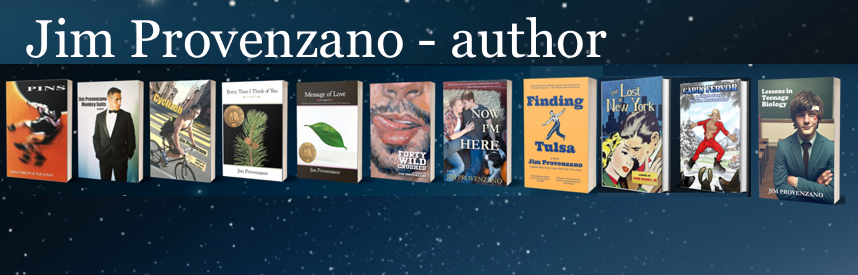
"Multi-talented Jim Provenzano is the Lambda Literary Award-winning author of six novels and a play based on one of them, PINS, that has been given local and regional productions. His latest novel, Now I'm Here, a story of first love, is available in paperback, Kindle and Kobo ebook editions (Beautiful Dreamer Press).

Charismatic Meg Elison has published the much-awaited conclusion to her Philip K. Dick Award-winning "Road to Nowhere" trilogy with The Book of Flora,"available in trade paperback and eBook (47North). 


Science fiction and fantasy devotees ate up the first two books in the trilogy, The Book of the Unnamed Midwife and The Book of Etta.
 

Read the full dual interview here:  https://www.ebar.com/arts_&_culture/books//280352

Read Meg Elison's books here: http://megelison.com/

Saturday, July 13, 2019

Great Book, A-hole Author: Should we judge writers for their work and their lives?

author Dale Peck
Ernest Hemingway was an alcoholic animal-hunting macho lout. Gertrude Stein supported fascism. Nicolas Sparks owns an allegedly bigoted Christian Camp. And now we have Dale Peck, a gay author whose bitter essay on openly gay Democratic presidential candidate Pete Buttigieg was so reviled that its publisher deleted the Op-Ed within hours of publishing it. But should we judge such authors' works by their behavior outside of their literary works?

One could start with the earliest classic stories by Homer and judge Greek culture for its dubious ethics about sexual relationships between men and boys.

Jumping forward several centuries, similar critiques can be made about author Horatio Alger and his series of books about strapping young boys who enjoyed the support of rich older men. Sexual favors lurk between the lines in many of his tales. And the author, according to Wikipedia, in 1866, "had been charged with 'the abominable and revolting crime of gross familiarity with boys.' Alger denied nothing, admitted he had been imprudent, considered his association with the church dissolved, and left town."

Switching gears to machismo in men of letters, Ernest Hemingway was known to drink to excess, shoot off guns and be abusive to women. Does that mar the legacy of classics like For Whom the Bell Tolls?


Gertrude Stein
As for lesbian poet Gertrude Stein, a pal of Hemingway, her sympathies for the then-growing Nazi regime are well documented. This article by Barbara Will for the National Endowment for the Humanities tells of the poet's support of the Vichy regime.

"Throughout her life Stein hewed to the political right, even signing up to be a propagandist for an authoritarian, Nazi-dominated political regime," writes Will. 

Also, "Most of Stein’s critics have given her a relatively free pass on her Vichy sympathies. Others have tried to ignore or justify equally inexplicable events: for example, Stein’s endorsement of Adolf Hitler for the Nobel Peace Prize in 1934, or her performance of the Hitler salute at his bunker in Berchtesgaden after the Allied victory in 1945. Until recently, in fact, the troublesome question of Stein’s politics didn’t really figure in debates over her legacy—as opposed, for example, to the vehement debates surrounding Mussolini supporter and modernist poet Ezra Pound."

Will also mentioned Pound."The modernist writer Ezra Pound took a similar tack in his propaganda on behalf of Mussolini. In his book Jefferson and/or Mussolini, Pound credited Italian fascism with bringing back “Jeffersonian” economic and agrarian values to the modern world."

This, course, omits the facts that Jefferson, a politician and author, was also a slave-owner who fathered children with a female African slave. Are we to disdain Jefferson's eloquent writings as hypocritical? Should we tear down monuments to him, as many Southern cities and universities have done with statues commemorating Robert E. Lee and other Confederate historical figures? Need we remind adherents to the Civil War, waving their 'Old Dixie" flags from their truck beds, that the South lost the war?

Wednesday, June 12, 2019

ACT UP on 'Pose' - revisiting a pivotal day

As one of the 111 ACT UP members arrested in the Stop the Church action of December 1989, it was wonderful to see the AIDS Coalition To Unleash Power included in the Season 2 premiere episode of the FX series Pose. The groundbreaking series focuses on the New York City ball communities of color, and transgender women struggling to make ends meet by building  chosen families.

I particularly loved seeing nurse Judy Kubrak (Sandra Bernhard) almost dragging a reluctant Pray Tell (Billy Porter) to his first meeting. Bernhard discusses ACT UP, and many other contemporary topics, in an expansive wonderful new interview for The Daily Beast.

The depiction of the group meeting was a bit simplistic, but served its purpose. It would be impossible to share the months of preparation that went into the Stop the Church protest, and the divisions within our ranks at the time over the action.

Other critiques and comments on the episode are included in a deft account by writer/editor Mathew Rodriguez for TheBody.com.
"Northrop did have some slight criticisms of the short depiction of the action in Pose -- mainly that it didn't capture just how big the demonstration really was. While there were hundreds of protesters inside, there were thousands outside protesting quite loudly. The protest included some of ACT UP's most well-known iconography, including artist and ACT UP member Ray Navarro dressed as Jesus and the poster of John Cardinal O'Connor next to an unrolled condom that said, "Know Your Scumbags."
Anachronisms aside (it took place on December 10, 1989, not in 1990). The episode is set in winter, a few weeks or months later, so that's a small quibble. I saw it as a choreographic version of Pray Tell’s participation and empowerment.

ACT UP meeting in 'Pose'
Laying down in the aisles was just one of many aspects of the protest, and I was among those, in an affinity group called The Order of the Carmelites, who reenacted laying prostrate in the aisle as the historic nuns did. A larger affinity group called The Marys did the same. Unlike the Pose version, it was not an inspired spontaneous action, but a carefully orchestrated series of movements.

Of course the most 'scandalous' moment in the action (not included in the TV show), and covered by media as 'an outrage,' was that of former altar boy Tom Keane breaking a sacrament wafer at the altar.

The other shots in the Pose episode portrayed the screaming and arrests, which were not as lengthy inside as shown, except for the then-irascible Michael Petrelis, who instead of following the silent die-in theme, chose to stand atop a pew seat and repeatedly shout "Stop Killing Us!"

But these critiques are minor when one considers the gift of including this momentous event through an artistic lens in a hit TV show.

My own fictionalized account in my 2007 third novel, Cyclizen, included all that, but most specifically, being carried off on a stretcher by NYPD (in basic caps; the riot gear and helmets were worn by police outside, not as depicted in Pose). Like the show, my own depiction is personalized and literary, not documentary-style.

One overhead shot of Pray Tell being carried out with others on a stretcher echoed my own experience, a sort of epiphany, that what we were doing was not only right, but a Christian thing to do, like Jesus chasing the money-changers out of the temple.

The episode could have included a few shots of historic news footage of the thousands outside the cathedral, which ended up having a larger impact over time. ACT UP leader Maxine Wolfe says as much in a documentary about the action. But the Pose script took on a more personal version, that of Billy Porter's and others' characters finding a way to fight back.