Can a history of 20th-century gay male authors (with a bit into the 21st) be both expansive and succinct? With Eminent Outlaws, author and essayist Christopher Bram has done that. He retells, in succinct form, the major authors' early successes, later failures, and how their lives often intertwined as colleagues and 'frenemies.'
Beginning with pioneering writers Gore Vidal and Truman Capote (and their mutual rivalries), Bram curates a fascinating tour of the pre-Stonewall daring of these and other authors. Throughout the book, he offers no discretion by quoting scathingly anti-gay critics of each era.
Tennessee Williams, a friend to both Vidal and Capote, is given generous exploration, from his early theater successes to his later troubled life after his partner Frank Merlo's death. Later in the book, playwrights Edward Albee, Mart Crowley, Larry Kramer and Tony Kushner's groundbreaking yet different works are recounted, from their historic plays' inspirations and premieres to the (again) vituperative attacks amid praise by (mostly -thankfully- forgotten) critics.
James Baldwin is quoted for his social commentary and, like Vidal and Capote, exemplifies the shift toward authors becoming 'telegenic.' (Imagine this writer, fascinated by a few of these authors on '70s talk shows via some innate gaydar, and later, while still a theater and dance student, privately scribbling bad poems and short stories influenced first by probable bisexual Jack Kerouac, and later by openly gay authors).
Bram also traces Baldwin's numerous treks from America to France, and his struggles with being boxed into gay and 'Black' categories. Expatriate, British/California author Christopher Isherwood's life from Berlin to Santa Monica shows the breadth of his work, and how stage and film adaptations of his stories changed his life.
Edmund White's career is given plenty of depth, from his homocentric/erotic works to more dreamlike tomes, and even his nonfiction works on sexuality and American rural gays.
Poets get a healthy nod, including, of course, Alan Ginsberg's infamous "Howl" publication and the ensuing legal battle. Frank O'Hara and the less remembered James Merrill get coverage.
Armistead Maupin is given ample exploration, from his early Chronicle serial to the multiple Tales of the City books, and his further success with The Night Listener.
Some mentions are more brief, like the short-lived Violet Quill and its authors (Felice Picano, Andrew Holleran and Edmund White being the only surviving members), and the later AIDS-era satirist David B. Feinberg. Bram also modestly excludes his own prolific output of acclaimed novels.
Later authors Michael Cunningham, David Leavitt, Stephen McCauley and others are included toward the end, rounding out this impressive survey of how literature was shaped beyond the gay genre and into larger readership. Additionally, Bram weaves in the rise and fall of independent gay bookstores, big publishers' '80s and '90s support of gay authors, and how each aided gay fiction's growth in spite of later omission by mainstream media.
Bram weaves a deft combination of history, biography, and even critical treatments of each writers' best and lesser known works. Stonewall, the rise of the AIDS epidemic, politics from the '50s to the millennium, are smartly contextualized as reflections of each writer's output.
Having read many of the works cited, including the expansive biographies of several authors, reading it became a bit of a thrill ride ("I knew that! Oh, I didn't know that!'). I hope that Eminent Outlaws is included in every LGBT Literature class. Each chapter shares a fascinating overview that should hopefully inspire further reading into the collective literary past.
Saturday, May 9, 2020
Sunday, May 3, 2020
Pandemic posts and recycled book reviews
I've decided to start reposting my GoodReads/Amazon book reviews on my
blog, because who needs more essays about enduring the pandemic? Not to say that such writings aren't helpful. I'm just focusing my efforts elsewhere.
Like some, I'm thankfully still employed.
Among my duties are sharing updates on the many online events and fundraisers hosted my Bay Area nightlife, arts and community groups. My latest Homing's In events list includes music, dance, film, opera and fun drag shows. Some are global, like operas and film screenings. Many are set to specific dates, while others are ongoing.
I also write a fun article about the recent GLAAD and Broadway.com Sondheim celebration online events, two of the most popular with a definite queer interest. Meryl Streep, Christine Baranski and Audra McDonald singing "The Ladies Who Lunch" from 'Company' while sipping booze in bathrobes was a popular highlight.
Locally, the San Francisco Queer Nightlife Fund has raised nearly $160,000 to help hundreds of bartenders, staff, DJs and performers in this crisis. My article about that effort is Here.
And speaking of saving jobs, the Bay Area Reporter's fundraiser has been extended through May.
Nearly 300 donors have been very generous. If you can't donate, just share the link to spread the word and help save the longest-running LGBT newspaper.
Now, on to the recycled yet still relevant book reviews.
First, my review of Pat Murphy's now-prescient The City, Not Long After.
Rereading this sweet post-plague story in San Francisco, where the book is set, rings strange and ironic. Would that a colony of artists could defend the city from invaders (the contemporary version would be the deranged rightwing protests to 'open the city' i.e. force other workers to put themselves at risk to accommodate them).
While that comparison be not be spot-on, others are. The various characters make art out of a sort of spontaneous inspiration (contemporary version: the numerous murals painted on boarded-up storefronts and the dozens of local online fundraisers for artists and arts nonprofits).
The story is part magical, part practical. Ghosts haunt the empty homes and office buildings. How do the few various survivors get on, and get along? How do they counter an inane fascist horde? Butterflies, paint, solar-powered robots and peaceful community-built empathy work for the characters in this book. Murphy's realistic and combined metaphoric story has become, in a way, quite prescient.
For the most part (excluding the real-life dopes still gathering in public without face masks) that's true here and now in San Francisco... except for the robots, which would be a nice addition.
Like some, I'm thankfully still employed.
Among my duties are sharing updates on the many online events and fundraisers hosted my Bay Area nightlife, arts and community groups. My latest Homing's In events list includes music, dance, film, opera and fun drag shows. Some are global, like operas and film screenings. Many are set to specific dates, while others are ongoing.
I also write a fun article about the recent GLAAD and Broadway.com Sondheim celebration online events, two of the most popular with a definite queer interest. Meryl Streep, Christine Baranski and Audra McDonald singing "The Ladies Who Lunch" from 'Company' while sipping booze in bathrobes was a popular highlight.
Locally, the San Francisco Queer Nightlife Fund has raised nearly $160,000 to help hundreds of bartenders, staff, DJs and performers in this crisis. My article about that effort is Here.
And speaking of saving jobs, the Bay Area Reporter's fundraiser has been extended through May.
Nearly 300 donors have been very generous. If you can't donate, just share the link to spread the word and help save the longest-running LGBT newspaper.
Now, on to the recycled yet still relevant book reviews.
First, my review of Pat Murphy's now-prescient The City, Not Long After.
Rereading this sweet post-plague story in San Francisco, where the book is set, rings strange and ironic. Would that a colony of artists could defend the city from invaders (the contemporary version would be the deranged rightwing protests to 'open the city' i.e. force other workers to put themselves at risk to accommodate them).
While that comparison be not be spot-on, others are. The various characters make art out of a sort of spontaneous inspiration (contemporary version: the numerous murals painted on boarded-up storefronts and the dozens of local online fundraisers for artists and arts nonprofits).
The story is part magical, part practical. Ghosts haunt the empty homes and office buildings. How do the few various survivors get on, and get along? How do they counter an inane fascist horde? Butterflies, paint, solar-powered robots and peaceful community-built empathy work for the characters in this book. Murphy's realistic and combined metaphoric story has become, in a way, quite prescient.
For the most part (excluding the real-life dopes still gathering in public without face masks) that's true here and now in San Francisco... except for the robots, which would be a nice addition.
Friday, April 3, 2020
Bay Area Reporter fundraising campaign
The Bay Area Reporter has been a vital news source to the LGBTQ community for almost 50 years. It’s also been my employer for more than 25 years.
For book fans, the B.A.R.’s reviews have supported hundreds of LGBTQ authors as well.
Like most small businesses, we’re facing financial hardship for staff, full-time and freelancers.
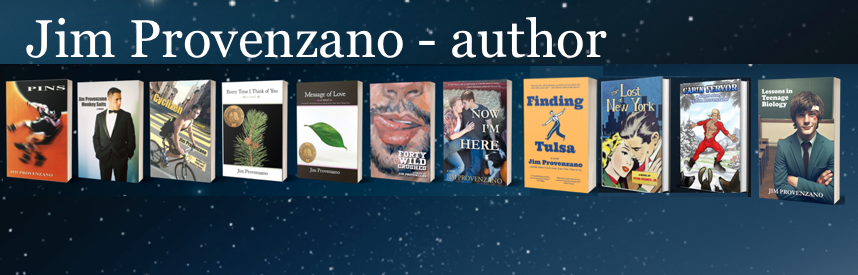
So I’m helping out by offering sets of four of my acclaimed novels for $100, personally inscribed and mailed to you. If you can only donate a few dollars instead, that’s still appreciated.
Can’t donate? Then please share with your friends and social media followers. Thank you!
Please donate to the B.A.R. fundraiser and share the link:
https://igg.me/at/save-the-BAR
Here's the video I made that explains our situation, and showcases the vivid history of the B.A.R.'s decades of coverage in news, arts and nightlife.
Sunday, March 1, 2020
March into the Midwest: Now I'm Here at Prologue Bookshop
Touring bookstores to promote one's books can be very expensive and time-consuming, which is why I'm happy to announce that I'll be reading from and discussing my sixth novel, Now I'm Here, at Prologue Bookshop in Columbus on March 12. That the novel is set in a small fictional town near Columbus, and that I spent a few years at Ohio State University, makes this event particularly poignant. The store will also have a few copies of my first novel, PINS for sale.
The last time I visited Columbus was in December 1999. I read from my first novel, PINS, to an appreciative audience at the now-closed An Open Book (749 N. High St.), and stopped by Cat's Impetuous Books in Stow, where I studied theatre for two years in nearby Kent.
It's hard to believe it's been twenty years since my last visit to Ohio. But with my family gone and few high school and college friends still there, traveling back there isn't as much of an option.
But when a representative from the Columbus Tourism invited me on a press trip to write about the city's Short North district and growing LGBT community, of course I offered an enthusiastic 'Yes!' and contacted Prologue Bookshop next, because I saw that they host a monthly LGBT book club.
Book Loft, another great store in the area, ordered a few copies of Now I'm Here, which I'll sign on Friday March 13, at around 2pm.
While it's difficult to not feel a bit envious of authors who get national book tours arranged for them by their big publishers, I do feel a sense of pride that I not only arranged those long-ago events myself, but garnered a few reviews and interviews in several regional Ohio publications, including the now-gone Gay People's Chronicle, which gave my event a generous and knowledgeable two-page spread!
This time, I did get a few bites from local media, including this Q&A in City Scene:
Prizm News, the new statewide LGBT publication, also granted me some coverage, with this Q&A:
If you're on Facebook, RSVP on the event page. If you can't attend, but are nearby, please order a copy of Now I'm Here from the store.
![]() |
| GPC coverage of PINS in 1999 |
It's hard to believe it's been twenty years since my last visit to Ohio. But with my family gone and few high school and college friends still there, traveling back there isn't as much of an option.
But when a representative from the Columbus Tourism invited me on a press trip to write about the city's Short North district and growing LGBT community, of course I offered an enthusiastic 'Yes!' and contacted Prologue Bookshop next, because I saw that they host a monthly LGBT book club.
Book Loft, another great store in the area, ordered a few copies of Now I'm Here, which I'll sign on Friday March 13, at around 2pm.
While it's difficult to not feel a bit envious of authors who get national book tours arranged for them by their big publishers, I do feel a sense of pride that I not only arranged those long-ago events myself, but garnered a few reviews and interviews in several regional Ohio publications, including the now-gone Gay People's Chronicle, which gave my event a generous and knowledgeable two-page spread!
This time, I did get a few bites from local media, including this Q&A in City Scene:
"Being openly gay has never been easy, but some eras were more challenging than others. The AIDS crisis and rampant homophobia of the '80s certainly didn’t help the fight for gay rights. Author Jim Provenzano captures a story of love in this tumultuous time in his 2018 book Now I’m Here.
Prologue Bookshop has scheduled Provenzano to read and sign his book on March 12 at 7 p.m. It will be the first time in 20 years that this OSU alumnus will return to Columbus. Using his experience growing up in Ohio, Provenzano creates incredibly realistic characters in his sixth novel."
![]() |
| Prologue Bookshop |
"The story is saturated with subtle pieces of Provenzano’s past, including a love for Queen music and a unique experience on a pumpkin farm. The narrative also touches on topics of religious intolerance, abuse, and the heartbreak of AIDS."For directions, visit Prologue's website. You should also follow their Instagram page for fun book recommendations.
If you're on Facebook, RSVP on the event page. If you can't attend, but are nearby, please order a copy of Now I'm Here from the store.
Subscribe to:
Posts (Atom)


